



Thymogen (Glu-Trp) and Immune Cell Regulation: How a Thymic Dipeptide Modulates Lymphocytes
Thymogen (sometimes referred to as Thymagen) is one of the smallest peptide bioregulators studied — just two amino acids, L-glutamic acid and L-tryptophan (L-Glu-L-Trp) — yet it is investigated for a surprisingly broad set of immune-cell actions. This research-use-only review covers how Thymogen may support T-lymphocyte differentiation, shift the cAMP/cGMP balance, influence stress resistance, and even modulate abnormal cell growth in animal models, plus the striking way its mirror-image D-form reverses its activity entirely.
Research-use-only disclaimer: Thymogen supplied as a research chemical is intended strictly for in-vitro and laboratory research use and is not intended for human or veterinary use in that context. Every finding below is drawn from cell-culture or animal models and is described in hedged, mechanistic terms. Nothing here is medical advice.

TL;DR
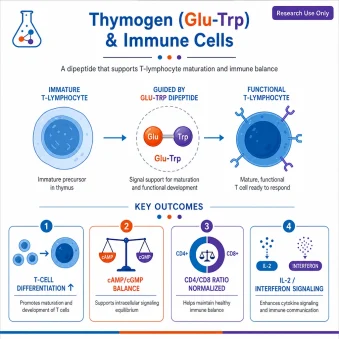
Thymogen is a synthetic L-Glu-L-Trp dipeptide (~333 Da) derived from the thymic preparation thymalin. In immune-cell research it is linked to T-lymphocyte differentiation, a shifted cAMP/cGMP balance, IL-2/interferon signaling, CD4/CD8 normalization, greater stress resilience, and improved immune surveillance as evidenced by modestly reduced tumor occurrence in animal models. Its D-enantiomer (Thymodepressin) does the opposite. Research use only.
Identity: L-Glu-L-Trp dipeptide (~333 Da), the active fragment of thymalin; a Khavinson short-peptide bioregulator.
Signaling: shifts the cAMP/cGMP ratio in lymphocytes, likely via phosphodiesterase activity.
Differentiation: supports maturation of T-lymphocyte precursors; associated with CD4/CD8 normalization and IL-2/IFN signaling.
Resilience: linked to protection under ischemia/reperfusion and microbial-challenge models.
Chirality twist: the D-form (D-Glu-D-Trp / Thymodepressin) is immunosuppressive — the opposite of Thymogen.
What Is Thymogen and Where Does It Come From?
Thymogen is a synthetic dipeptide made of L-glutamic acid linked to L-tryptophan (Glu-Trp), with a molecular weight of roughly 333 Da — among the simplest possible peptide structures. It was identified by a team led by Khavinson and colleagues as the active dipeptide fragment of thymalin, a more complex thymus-derived peptide preparation distinct from Thymosin alpha 1, and it belongs to the family of Khavinson short-peptide bioregulators.
Small peptides of this kind are hypothesized to enter cells readily and reach intracellular compartments — including the nucleus — that larger molecules cannot, suggesting a unique mechanism of action. Within the Khavinson model, a dipeptide such as Thymogen is viewed as a signaling molecule that may help guide the molecular activity, tissue repair, and gene expression of immune cells, effectively substituting a defined two-residue sequence for the activity of a much larger thymic protein mixture.
How Does Thymogen Influence cAMP/cGMP Signaling?
One proposed route by which Thymogen acts on immune cells is the cyclic nucleotide system — the intracellular messengers cyclic AMP (cAMP) and cyclic GMP (cGMP), which help set the balance between activating and restraining responses. In lymphocyte experiments, Demidov et al. (1991) examined how Thymogen affects cAMP and cGMP levels and the phosphodiesterase enzymes that break cyclic nucleotides down.
The authors reported that the actions of Thymogen appeared to be "connected with the cyclic nucleotide system," and that under sensitization conditions the cAMP/cGMP ratio tended to shift, with the peptide supporting the enzymes responsible for cyclic-nucleotide catabolism. In broader characterizations, Thymogen has also been associated with increased cAMP in T-lymphocytes. Because the cAMP/cGMP ratio helps determine the direction and magnitude of immune responses, adjusting that balance is one plausible way a small peptide could modulate immune-cell signaling.
How Does Thymogen Support T-Lymphocyte Differentiation?
A recurring theme is that Thymogen may support the maturation, or differentiation, of T-lymphocytes — the cells that coordinate many immune responses and that normally mature under thymic support. Because Thymogen is structurally derived from thymic peptide material produced by the thymus gland, researchers hypothesize it acts as a regulatory signal favoring the development of these cells and potentially influencing natural killer cells within the innate immune system.
In a study by Zhuk and Galenok (1996) examining lymphocyte populations under immune insufficiency or autoimmune disorders, Thymogen exposure was associated with reduced laboratory signs of secondary immunodeficiency and an "activation of T-lymphocyte differentiation." Broader characterizations of L-Glu-L-Trp describe stimulation of T-lymphocyte precursors into mature immunocompetent cells, normalization of the T-helper/T-suppressor (CD4/CD8) ratio, and effects on cytokine output, including the potential to reduce inflammation through the regulation of pro-inflammatory cytokines such as interleukin-2 (IL-2) and interferon (IFN).
Does Thymogen Affect Cellular Stress Resistance?
Several models suggest Thymogen exposure is associated with greater cellular resilience under stress, potentially through antioxidant pathways. Filippova et al. (1997) studied the peptide during reduced-oxygen states of cardiac muscle cells and reperfusion, reporting an apparent protective effect that — notably — did not appear to depend on common antioxidant or protective mechanisms such as opiate receptors or blockade of calcium entry, though the precise mechanism was not resolved.
Microbial-challenge models point the same direction. Iushchuk et al. (1995) reported that Thymogen supported nonspecific resistance in a Yersinia enterocolitica model, and Khmel'nitskii et al. (1990) observed a less severe spread of Candida in experimental cultures under immunodepression, suggesting Thymogen stimulated the innate immune system and immunocompetent cells toward better activation and defense. Together these hint that Thymogen may support the functional capacity of immune cells across different challenges.
What About Abnormal Cell Growth?
Because a Because a peptide that supports T cell function, immune-cell activity, and gene expression might, in turn, influence abnormal proliferation, several groups examined Thymogen in tumor models.
These observations are interpreted as consistent with the broader hypothesis that a peptide supporting T cell function and general immune-cell activity may be associated with reduced abnormal cell growth in certain models — not as evidence of anticancer efficacy.
Why Does Chirality Matter: Thymogen vs. Thymodepressin?
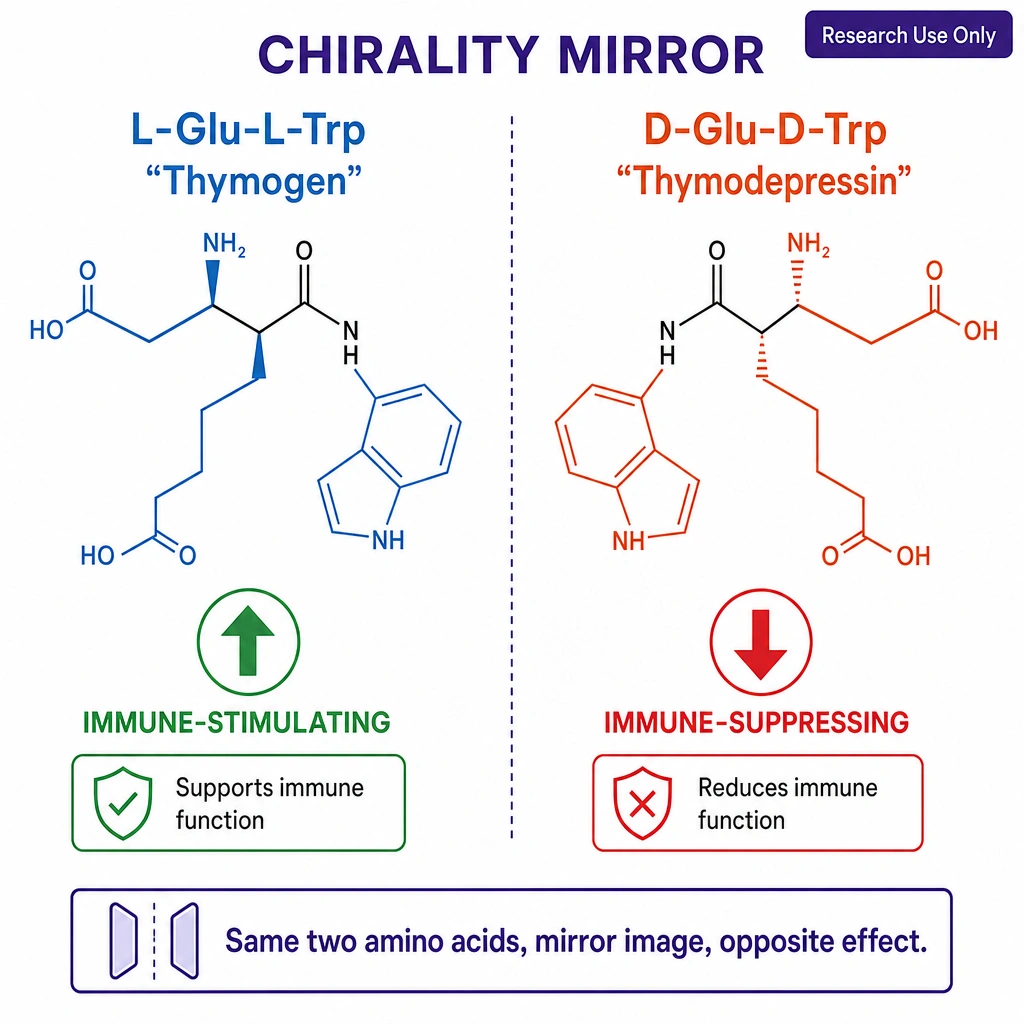
One of the most instructive facts about the Glu-Trp scaffold is what happens when you flip its stereochemistry. Thymogen is the L-form (L-Glu-L-Trp) and is immunostimulatory. Its mirror image, the D-form (D-Glu-D-Trp) — marketed as Thymodepressin — exhibits the opposite biological activity: immunosuppression.
For a research audience, this is a clean, memorable illustration of how chirality can reverse a peptide's biological direction: the same two amino acids, the same connectivity, but opposite effects on immune-cell behavior depending on handedness. It also underscores why identity verification (including stereochemistry) matters for a compound this small.
| Feature | Thymogen (L-form) | Thymodepressin (D-form) |
|---|---|---|
| Sequence | L-Glu-L-Trp | D-Glu-D-Trp |
| Immune direction | Immunostimulatory | Immunosuppressive |
| T-cell effect | Supports differentiation/maturation | Restrains immune activity |
| Research use | Immune-support models | Immunosuppression models |
How is research-grade Thymogen characterized?
Because Glu-Trp is a two-residue peptide whose activity is stereochemistry-dependent, identity verification is central. Research-grade Thymogen is typically confirmed by reversed-phase HPLC for purity and mass spectrometry for identity, handled cold, and supplied for laboratory use only. At PrymaLab, research peptides are characterized with HPLC/MS verification and independent third-party testing. No specific lot data are asserted in this general reference.
Frequently Asked Questions
What is Thymogen?
Thymogen (sometimes referred to as Thymagen) is a synthetic L-Glu-L-Trp dipeptide (~333 Da), the active fragment of the thymic preparation thymalin and a Khavinson short-peptide bioregulator. It is for research use only.
How does Thymogen affect immune cells?
It is linked to T-lymphocyte differentiation, a shifted cAMP/cGMP balance (via phosphodiesterase activity), IL-2/IFN/TNF signaling, and normalization of the CD4/CD8 ratio in research models.
How does Thymogen support T-lymphocyte differentiation?
Derived from thymic peptide material, it is hypothesized to help immature T-cell precursors mature. Zhuk and Galenok reported activation of T-lymphocyte differentiation and reduced signs of secondary immunodeficiency, though research in other viral models like hepatitis B or autoimmune disorders remains distinct.
What is the difference between Thymogen and Thymodepressin?
They are enantiomers. Thymogen (L-Glu-L-Trp) is immunostimulatory; the D-form (D-Glu-D-Trp, Thymodepressin) is immunosuppressive — opposite activities from the same sequence.
Does Thymogen affect abnormal cell growth?
In animal models, modestly: Bespalov et al. reported ~12% lower tumor occurrence and ~1.7-fold fewer tumors per model, and Anisimov et al. reported reduced radiation-induced carcinogenesis — interpreted as immune-supportive, not anticancer efficacy.
Is Thymogen approved for human use?
Material sold as a research chemical is for laboratory use only and is not intended for human or veterinary use. This article covers cellular mechanisms only.
References
- Khavinson VK, Lin'kova NS, Tarnovskaya SI. Short Peptides Regulate Gene Expression. Bull Exp Biol Med. 2016;162(2):288–292. PMID:27909961
- Bespalov VG, Troian DN, Petrov AS, Morozov VG, Khavinson VKh. Inhibiting effect of thymogen on the development of tumors of the esophagus and forestomach induced by N-nitrososarcosine ethyl ester in rats. Eksp Onkol. 1989;11(4):23–26. PMID:2759010
- Demidov SV, Kostromin AN, Kuĭbeda VV, et al. Effect of thymogen, thymalin and vilosen on the cAMP and cGMP levels and phosphodiesterase activity in spleen lymphocytes during sensitization and anaphylactic shock. Ukr Biokhim Zh. 1991;63(4):104–106. PMID:1659006
- Zhuk EA, Galenok VA. Thymogen in the treatment of type-1 diabetes mellitus. Ter Arkh. 1996;68(10):12–14. PMID:9026934
- Filippova OV, Reznikov KM, Alabovskiĭ VV, et al. The effect of thymogen on the heart in ischemia and reperfusion. Eksp Klin Farmakol. 1997;60(3):27–29. PMID:9324392
- Iushchuk ND, Tseneva GIa, Alenushkina TV, Kuliashova LB. The efficacy of using thymogen in an experimental infection caused by Yersinia enterocolitica. Zh Mikrobiol Epidemiol Immunobiol. 1995;(3):106–108. PMID:7660690
- Khmel'nitskiĭ OK, Iakovlev GM, Belianin VL, et al. The effect of a synthetic thymus peptide (thymogen) on the immune system in candidiasis under immunodepression. Arkh Patol. 1990;52(1):20–25. PMID:2337388
- Anisimov VN, Miretskiĭ GI, Morozov VG, et al. The effect of the synthetic immunomodulator thymogen on radiation-induced carcinogenesis in rats. Vopr Onkol. 1992;38(4):451–458. PMID:1300740
Final disclaimer: This article is an educational research reference. Thymogen supplied as a research chemical is for laboratory research use only and is not intended for human or veterinary use in that context. Statements have not been evaluated by the FDA. Nothing here should be interpreted as medical advice or as a claim of immune or anticancer efficacy in humans.
Mechanistic descriptions are observations from cell and animal models, several from older literature, that may not generalize. Always verify the legal status of any research compound in your jurisdiction before purchase or use.